When the Yield Turns Toxic: Understanding the Hidden Blow-Up Risk in High-Carry Currency Trades
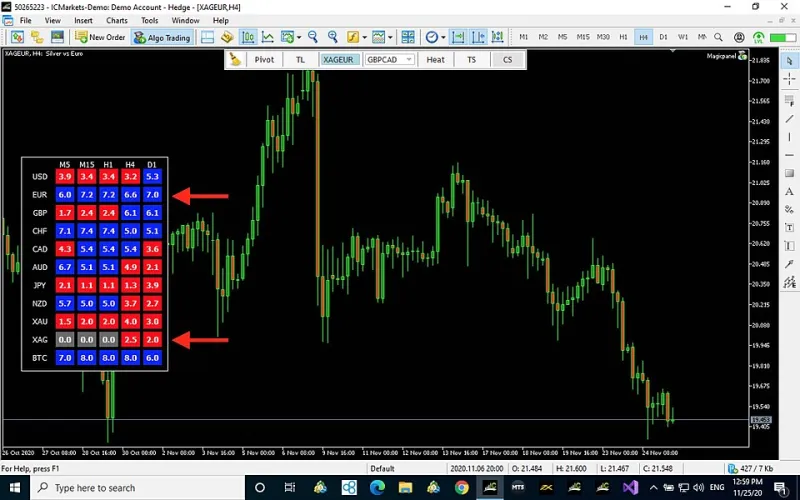
Photo: Magic Panel (FX), CC BY-SA 4.0, via Wikimedia Commons
There is an old saying among currency traders: carry trades go up by the stairs and come down by the elevator. It is a deceptively simple metaphor for one of the most dangerous dynamics in forex — the tendency for high-yield positions to generate slow, grinding returns during calm periods, only to implode with extraordinary speed the moment market conditions shift. For retail traders drawn to the income potential of exotic currency pairs, understanding this asymmetry is not optional. It is the difference between building a sustainable strategy and walking into a financial ambush.
The Seduction of the Interest Rate Differential
At its core, a carry trade is straightforward: borrow in a low-yield currency, deploy capital in a high-yield one, and pocket the difference. When a US-based trader buys the Mexican peso against the Japanese yen, for example, they are effectively earning the spread between Banco de México's benchmark rate and the Bank of Japan's near-zero policy rate. On a leveraged position, even a modest differential can translate into meaningful annualized returns.
The appeal is easy to understand, particularly in an environment where many traders are searching for yield wherever they can find it. Emerging market currencies from Turkey, Brazil, South Africa, and Indonesia have all attracted carry-seeking capital at various points over the past decade. The numbers look compelling in a spreadsheet. The danger, however, lies in what the spreadsheet cannot capture: the behavioral and structural forces that make these trades catastrophically correlated with broader risk sentiment.
Why Stress Events Are the Carry Trader's Worst Enemy
The fundamental problem with high-carry exotic pairs is not that they are inherently flawed. It is that they are acutely vulnerable to the same conditions that tend to trigger every other form of market distress simultaneously. When volatility spikes — whether from a geopolitical shock, a sudden shift in Federal Reserve guidance, or a credit event in an unrelated market — investors around the world tend to do the same thing at the same time: they reduce risk exposure.
This behavior, often described as a flight to quality, pulls capital out of high-yield emerging market positions and into safe-haven assets like the US dollar, Japanese yen, and Swiss franc. The result is not a gradual unwind. It is a stampede. Liquidity in exotic pairs dries up almost instantly, bid-ask spreads widen dramatically, and the currency you are holding long can gap down several percentage points before you have a chance to react. The very leverage that amplified your carry income now amplifies your losses.
Historical Blow-Ups Worth Studying Closely
No examination of carry trade risk would be complete without revisiting January 15, 2015 — the day the Swiss National Bank abruptly removed the EUR/CHF floor it had maintained since 2011. In a matter of minutes, the Swiss franc appreciated by as much as 30 percent against the euro. Traders who had been short the franc — a common carry-adjacent position at the time — were wiped out. Several retail brokers became insolvent overnight. The event was a stark reminder that central bank policy, which carry traders often treat as a stable backdrop, can itself become the source of catastrophic tail risk.
More recently, the Turkish lira has provided multiple case studies in carry trade destruction. Throughout 2021 and 2022, the lira offered some of the highest nominal interest rates in the emerging market universe. Yet traders who positioned for those rates experienced serial devaluations driven by unorthodox monetary policy, inflation spiraling past 80 percent, and political pressure on the central bank. The nominal yield was rendered meaningless by the pace of currency depreciation.
Similar dynamics have played out in the Argentine peso, the South African rand during periods of political instability, and the Brazilian real during election cycles. The pattern is consistent: the higher the advertised yield, the more fragile the underlying macro environment tends to be.
Identifying Hidden Tail Risk Before You Enter
So how should a retail trader evaluate whether a high-carry position carries disproportionate blow-up risk? A structured pre-trade framework can help surface dangers that raw yield numbers obscure.
Examine the real interest rate, not just the nominal one. A currency offering a 40 percent nominal rate in an economy experiencing 35 percent inflation is not delivering 40 percent in purchasing power terms. Adjusting for inflation reveals whether the yield differential is genuinely attractive or simply compensating for currency erosion that has already begun.
Assess central bank credibility and political independence. Carry trades depend on rate differentials remaining stable long enough to generate returns. When a central bank operates under political pressure — or has a history of sudden, unannounced policy reversals — the rate you are counting on can disappear overnight. Tracking the IMF's assessments and monitoring local political news cycles are basic due diligence steps that many retail traders skip.
Measure the correlation between your carry pair and broader risk assets. If your high-yield currency tends to move in lockstep with the S&P 500 during periods of stress, you are not holding a diversified income position. You are holding a leveraged risk-on bet with a yield label attached. Running a rolling 60-day correlation between your target pair and the VIX or US equity indices can reveal this relationship clearly.
Stress-test your position against historical drawdown scenarios. Pull up the maximum peak-to-trough move the currency pair has experienced over the past five to ten years. Then apply your actual leverage ratio to that drawdown. If the result exceeds your account's margin buffer or your personal risk tolerance, the position is too large regardless of how attractive the carry looks.
Building a More Resilient Approach
None of this means carry trading is inherently reckless. Traders who have succeeded with the strategy over the long term tend to share several habits. They size positions conservatively relative to their account equity, accepting that lower leverage means lower income but also survivable drawdowns. They concentrate on carry pairs where the interest rate differential is supported by genuine macroeconomic fundamentals rather than crisis-level rates. And they treat carry income as a secondary benefit of a trade they would be willing to hold through turbulence — not as the primary rationale for entering in the first place.
Perhaps most importantly, experienced carry traders maintain clear exit criteria defined before the position is opened. Waiting until a currency is in freefall to decide how much loss is acceptable is a reliable path to disaster. The traders who survived the 2015 franc event largely did so because they had stop-loss orders in place and position sizes that could absorb a significant gap move.
The Honest Calculus of High-Yield Forex
High-carry currency pairs will continue to attract retail traders, and for understandable reasons. The yield differentials are real, and in stable market conditions, they can be harvested systematically. But the asymmetry of the risk profile — modest gains accumulated slowly, catastrophic losses arriving suddenly — demands a level of discipline and structural awareness that the initial yield calculation does not reveal.
Approaching these trades with clear eyes means acknowledging that the yield is compensation for risk, not a free lunch. When market stress arrives, that risk will be repriced — often all at once, and often at the worst possible moment. The traders who endure are the ones who prepared for that moment long before it came.