Five Letters, One Frozen Basket: Why the Dollar Index Is the Wrong Compass
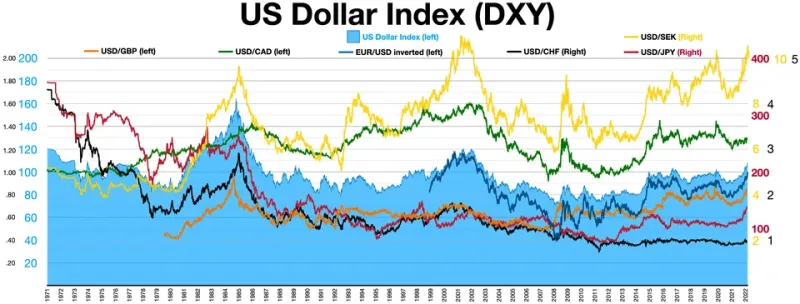
Photo: Wikideas1, CC0, via Wikimedia Commons
Ask an American retail trader how the dollar is doing and the answer usually arrives as a single number with five letters attached. DXY up, dollar strong. DXY down, dollar weak. The shorthand is convenient, universally quoted, and — for anyone actually trading currency pairs rather than a futures contract on an index — frequently misleading. The Dollar Index is not a measure of the dollar. It is a measure of the dollar against a specific, narrow, and increasingly aged group of counterparties.
What the Index Actually Prices
The US Dollar Index is a geometrically weighted average of the dollar against six currencies: the euro, the Japanese yen, the British pound, the Canadian dollar, the Swedish krona, and the Swiss franc. The weights are fixed, not floating. The euro accounts for roughly 57.6% of the basket. The yen contributes about 13.6%, sterling about 11.9%, the Canadian dollar about 9.1%, with the krona and franc making up the remainder.
Those weights were set when the euro was introduced and have not been meaningfully revisited since. The composition reflects the trade relationships of a much earlier era and omits, entirely, the currencies of Mexico, China, South Korea, Taiwan, India, Brazil, and Australia — several of which rank among the United States' largest trading partners today.
This is not a flaw in the index; it is a design choice inherited from a different purpose. But it means the index answers a narrower question than traders assume. It tells you how the dollar is performing against a European-heavy basket of developed-market currencies. It does not tell you how the dollar is doing against the world, and it certainly does not tell you what is happening to the specific pair on your screen.
The Euro Problem
Because the euro is nearly three-fifths of the index, DXY is close to a leveraged mirror of EUR/USD. When European political risk drives the single currency lower, the index rises — and it rises for reasons that may have nothing whatsoever to do with American economic strength. A trader who reads a rising DXY as confirmation of dollar bullishness may be watching a euro-negative headline dressed up as a dollar-positive signal.
This is not a technicality. It shapes how thousands of traders frame their bias each morning. A headline about German industrial production, French fiscal politics, or European Central Bank communication can move the index several tenths of a percent while USD/JPY, USD/CAD, and dollar-Asia pairs sit entirely still. The index is telling the truth about EUR/USD and something close to fiction about everything else.
Three Places the Illusion Breaks
Against the yen. USD/JPY responds to US Treasury yields, Japanese policy, and carry-trade positioning, not to European news. It is entirely routine for DXY to be flat or lower while USD/JPY trends persistently higher, because the yen leg has its own drivers. A trader using the index as a proxy for broad dollar direction will misread the pair that carries the largest share of retail speculative interest outside the majors.
Against the commodity currencies. The Canadian dollar trades with crude, the Australian dollar with Chinese credit conditions and iron ore, the Norwegian krone with North Sea energy economics. These are not European stories, and the index has no way to reflect them. During a commodity rally, the dollar can weaken against the currencies that matter for a resource-heavy portfolio while DXY holds firm.
Against emerging-market flows. The currencies that transmit global risk appetite most acutely — the Mexican peso, the South African rand, the Korean won — are outside the basket entirely. When capital rotates out of emerging markets into dollar assets, the index may register only a fraction of the stress, because the stress is concentrated where the basket does not look.
A Better Framework
Nothing here argues for discarding the index. It is liquid, widely watched, and useful as one input. The argument is that a single number cannot describe a multi-dimensional exposure, and that American traders can construct something better with modest effort.
A three-bucket approach is a reasonable starting point. First, a developed-market bucket: EUR/USD, USD/JPY, GBP/USD, and USD/CHF, which captures the funding-currency and rate-differential story. Second, a commodity and North American bucket: USD/CAD, AUD/USD, NZD/USD, and USD/NOK, which captures the resource cycle. Third, an emerging and trade-weighted bucket: USD/MXN, USD/CNH, USD/KRW, and a broad trade-weighted measure if one is accessible through the broker's research or a public source.
Track the three buckets separately, then ask a simpler question than whether the dollar is strong or weak: which of these buckets is driving my book today? Most trading days have one dominant driver and two passengers. Naming the driver before entering a trade is worth more than any single index print.
A second discipline is to normalize. Compare each pair's move to its own recent average range rather than to the index. A 0.4% move in EUR/USD and a 1.2% move in USD/MXN are not equivalent events, and the index, being geometrically weighted toward the euro, will always flatter the quiet pair.
What the Index Is Good For
The Dollar Index remains an excellent instrument for hedging broad dollar exposure, for reading positioning in currency futures, and for gauging sentiment among traders whose attention is concentrated in the majors. It is a fine thermometer for one room in a large house.
The error is in treating that thermometer as a description of the climate. The dollar is not a single object moving in a single direction. It is a set of relative prices, each with its own drivers, its own liquidity, and its own story. Traders who build their read from the pairs they actually hold — and use the index only as a background check — will find their analysis sharper and their surprises smaller.