False Breakouts and Fading Rallies: How Commodity Currencies Lure Retail Traders Into Losing Positions
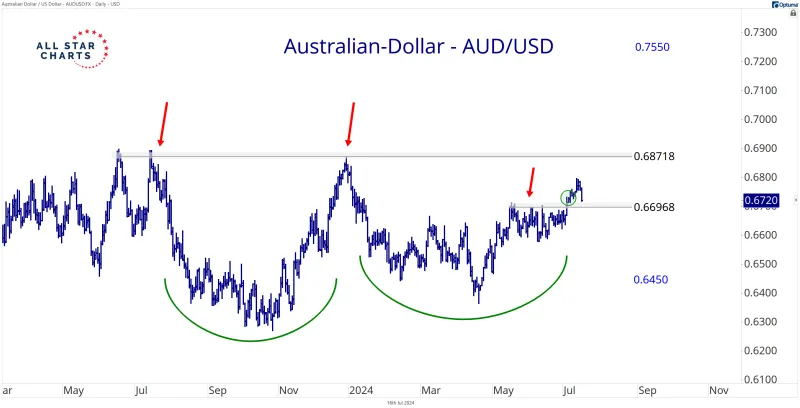
Photo: Australian dollar Canadian dollar currency trading commodities forex chart, via media-allstarcharts.s3.amazonaws.com
When Commodities Move, Currencies Follow — Until They Don't
For many retail forex traders in the United States, commodity-linked currencies carry an intuitive appeal. When iron ore prices surge, the Australian dollar should strengthen. When crude oil rallies, the Canadian dollar ought to follow. The logic is clean, the correlations are historically documented, and the chart setups can look convincingly directional. That intuitive appeal, however, is precisely what makes AUD/USD and USD/CAD among the most treacherous pairs for undercapitalized participants.
The mechanics of commodity currency traps are not accidental. They are, in many cases, a predictable consequence of how institutional capital positions itself ahead of mean reversion events — and how retail order flow arrives late, concentrated, and exposed.
The Anatomy of a Commodity Currency Rally
Genuine commodity currency strength is rooted in durable shifts in terms-of-trade dynamics. When Australia's export revenues rise sustainably — driven by multi-quarter demand from China's industrial sector, for instance — the Reserve Bank of Australia gains flexibility to maintain or tighten monetary policy, and capital inflows support AUD appreciation over a meaningful horizon.
What retail traders frequently encounter, however, is something far shorter-lived: a spike in spot commodity prices that generates headline momentum, triggers technical breakouts on widely-watched chart levels, and invites aggressive positioning before the fundamental picture has been confirmed.
Consider the pattern that repeated itself across 2024. Iron ore prices experienced sharp, short-duration rallies in the first and third quarters, each time lifting AUD/USD above resistance levels that retail sentiment surveys showed were being closely monitored. In both instances, the pair reversed within days of the breakout, with the Australian dollar retracing sharply as Chinese demand data disappointed and the U.S. dollar regained footing on Federal Reserve rate expectations.
The traders who bought the breakout — many of them sizing up positions on the assumption that commodity strength would persist — absorbed the full reversal. Those who had already been positioned by institutional desks at lower levels were selling into that retail demand.
The Canadian Dollar and the Crude Oil Mirage
USD/CAD presents a structurally similar trap, though the commodity driver shifts to energy markets. The Canadian dollar's sensitivity to WTI crude oil is well-established, and the correlation is strong enough that many retail traders effectively use USD/CAD as a proxy crude trade without fully accounting for the currency-specific dynamics layered on top.
During the oil price volatility of late 2024 and into 2025, the pair demonstrated several instances where a WTI rally of five to eight percent failed to produce sustained CAD appreciation. The reasons were multiple: Bank of Canada rate cut expectations were diverging from Fed policy in ways that created a monetary policy headwind for the loonie; Canadian housing market stress was weighing on domestic growth forecasts; and U.S. dollar demand from safe-haven flows was intermittently overwhelming commodity price signals.
Retail traders watching only the crude chart and entering short USD/CAD positions on energy strength found themselves fighting two forces simultaneously — a softening commodity impulse and a strengthening greenback — without the risk management infrastructure to absorb the drawdown.
Leading Indicators That Separate Genuine Strength From Noise
Distinguishing sustainable commodity currency appreciation from a short-term mispricing requires looking beyond spot commodity prices. Several leading indicators carry more predictive weight.
Terms of trade data — published quarterly by the Australian Bureau of Statistics and Statistics Canada — provides the most direct measure of whether export revenues are genuinely improving relative to import costs. A rising terms-of-trade index supports sustained currency strength; a flat or declining reading suggests any commodity-driven FX rally may be borrowed time.
Chinese PMI and industrial output figures matter disproportionately for AUD, given that China absorbs roughly a third of Australia's total exports. When manufacturing PMI readings from Beijing soften, the commodity demand underpinning AUD strength tends to weaken within four to six weeks — a lag that creates a window for informed traders to fade rallies before retail momentum fully builds.
Crude oil futures curve structure offers a useful filter for CAD trades. When the WTI futures curve is in backwardation — near-term contracts priced above forward months — it signals genuine supply tightness that tends to support CAD more durably. A contango structure, where forward prices exceed spot, often reflects speculative positioning rather than fundamental demand, making CAD rallies built on that crude move more vulnerable to reversal.
How Institutional Players Exploit Retail Positioning
The mechanics of the trap become clearer when viewed through the lens of market microstructure. Institutional desks accumulate positions in commodity currencies during periods of low volatility and weak momentum — precisely when retail interest is minimal. As commodity prices begin to move and technical breakouts materialize, retail flow accelerates, providing the liquidity that institutional players need to distribute their positions at favorable prices.
This dynamic is visible in Commitment of Traders data published by the CFTC, which tracks the positioning of large speculators and commercial hedgers in currency futures. During the AUD/USD breakout episodes of 2024, COT reports showed large speculative positions already near multi-month highs at the point when retail sentiment indicators were signaling the most bullish readings. The divergence between speculative positioning and retail sentiment is one of the clearest early warnings that a commodity currency rally is approaching exhaustion.
Practical Risk Protocols for Trading Commodity Pairs
For traders who want exposure to commodity currency dynamics without falling into the momentum trap, discipline around entry timing and position sizing is non-negotiable.
First, require confirmation from both the commodity market and a macroeconomic data point before entering in the direction of a breakout. A WTI rally alone is insufficient justification for a short USD/CAD position; a supportive Canadian employment report or a Bank of Canada statement that pushes back against rate cut expectations adds meaningful confirmation weight.
Second, treat COT positioning as a contrary indicator when large speculators are already heavily concentrated in one direction. Crowded trades in commodity currencies unwind quickly and without warning.
Third, size positions conservatively relative to the volatility profile of these pairs. AUD/USD and USD/CAD can move two to three percent in a single session when commodity sentiment shifts, and retail traders who have oversized their entries on the assumption of continuation frequently face margin pressure before any reversal has time to play out in their favor.
The commodity currency trade is not inherently flawed — but entering it on the basis of price momentum alone, without the macroeconomic and positioning context to support the thesis, is one of the most reliable ways to donate capital to better-prepared market participants.